4.3 Guide: Meal Reductions for Free Meals & Hotel Stays
Statutory per diem allowances are designed to compensate employees for elevated meal expenses incurred during their business travel. However, when an employer or host organization (commercial partner, conference organizer, lodging facility) provides meals free of charge, Czech labor law mandates a proportional reduction of the daily allowance.
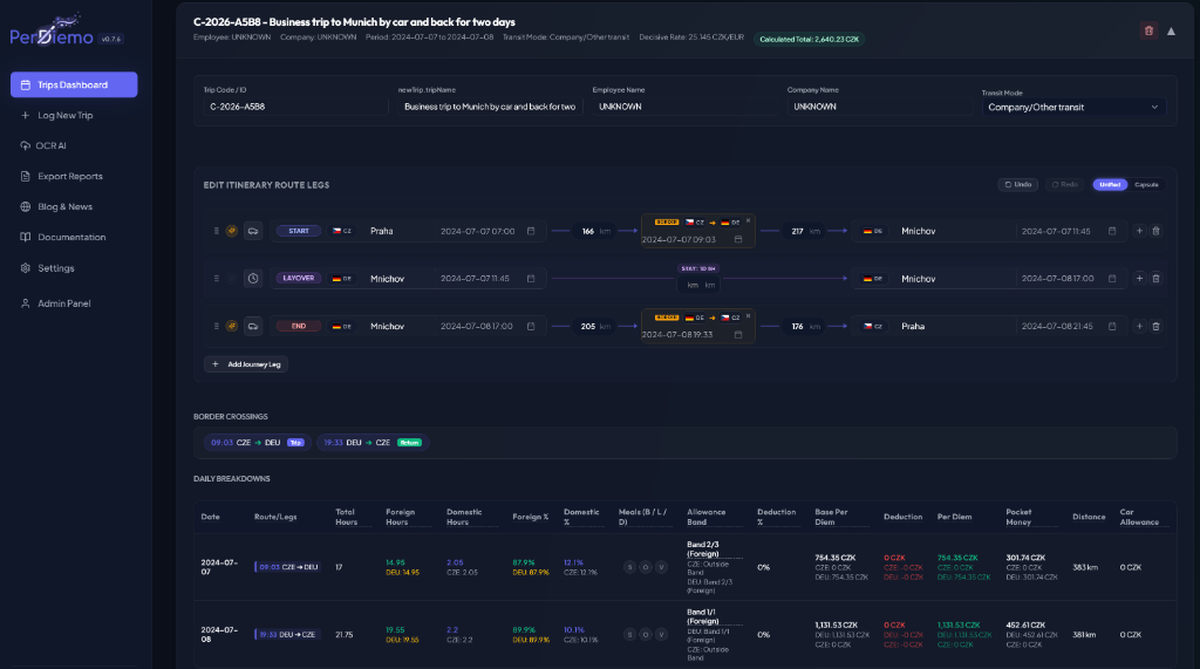
---
1. Statutory Principles of Meal Reductions
The statutory basis and deduction mechanics are governed by the Czech Labor Code (Act No. 262/2006 Coll.):
- Domestic Business Travel: Section 163 of the Labor Code
- Foreign Business Travel: Section 170(5) of the Labor Code for the business sector
- Foreign Business Travel: Section 179(3) of the Labor Code for the public/state sector
Under Czech legislation, deduction percentages are not fixed by meal type (breakfast, lunch, or dinner). The statutory reduction applied for each free meal is determined strictly by the active duration tier (hours spent on travel during that calendar day).
In the business sector, employers may agree in an employment contract or internal directive to apply lower deduction rates (or waive deductions entirely as an employee benefit under Section 163(2) of the Labor Code). In the absence of an explicit internal regulation, the statutory maximum rates detailed below apply automatically.
If a private-sector employer applies a lower reduction rate than mandated for the public and budgetary sector under Section 176 of the Labor Code (the mandatory 70%, 35%, and 25% rates), the portion paid above this statutory benchmark ceases to be a tax-exempt travel expense reimbursement.
Under Section 6(7)(a) of the Czech Income Tax Act, any difference resulting from reduced or waived statutory deductions becomes taxable employment income for the employee. Payroll accounting must include this excess in the assessment base for personal income tax withholding as well as mandatory social security and health insurance contributions.
---
2. Domestic Per Diems: Tiers and Deduction Rates (§ 163 ZP)
On domestic business travel, an employee becomes entitled to a per diem if the trip lasts at least 5 hours in a calendar day. For 2026, the Ministry of Labour and Social Affairs set the statutory rate brackets via Decree No. 573/2025 Coll. The deduction rate per provided free meal corresponds to the active duration tier:
| Duration Tier (Calendar Day) | Statutory Rate Bracket (2026) | Statutory Minimum (Business Sector) | Deduction per FREE Meal | Outcome with Full Board Provided |
|---|---|---|---|---|
| 5 to 12 hours | 155 CZK to 185 CZK | 155 CZK | -70% | 2 or more meals eliminate entitlement (0 CZK) |
| 12 to 18 hours | 236 CZK to 284 CZK | 236 CZK | -35% | 3 meals eliminate entitlement (0 CZK) |
| Over 18 hours | 370 CZK to 442 CZK | 370 CZK | -25% | 3 meals reduce allowance by 75% (25% remains) |
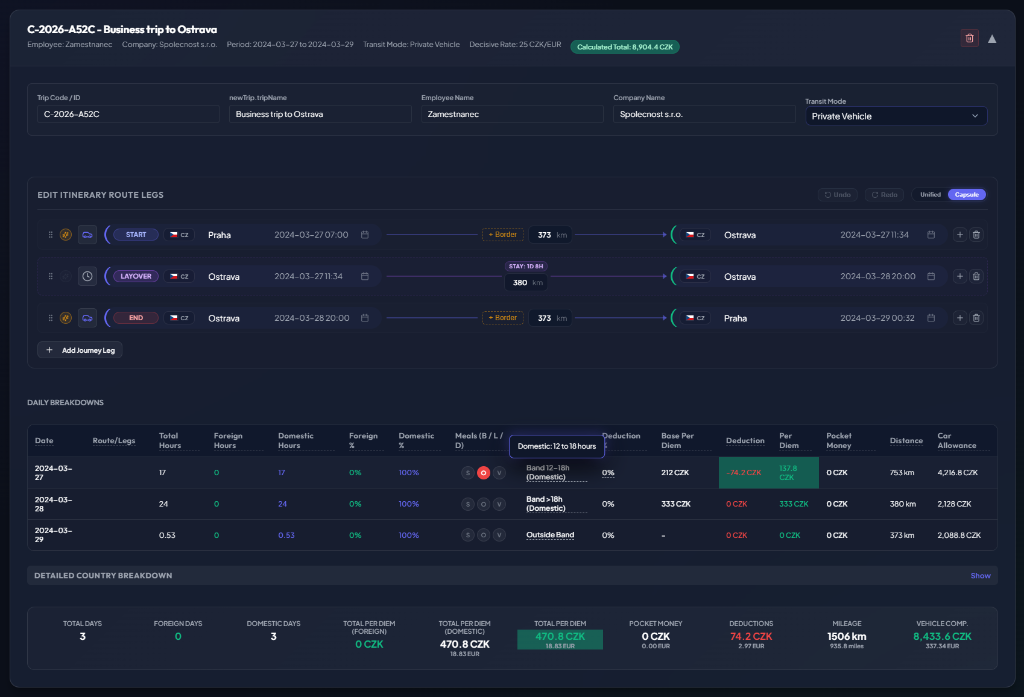
Elimination of Domestic Allowance Entitlement (§ 163(3) ZP):
The Czech Labor Code explicitly defines conditions under which travel subsistence is not payable at all: 1. When an employee is provided with 2 free meals during a trip lasting 5 to 12 hours (cumulative deduction reaches 140%, resulting in 0 CZK). 2. When an employee is provided with 3 free meals during a trip lasting 12 to 18 hours (cumulative deduction reaches 105%, resulting in 0 CZK). 3. Whenever the cumulative applied deduction reaches or exceeds 100%, the net allowance is capped at 0 CZK.---
3. Foreign Per Diems: Tiers and Deduction Rates (§ 170(5) ZP)
Foreign per diems are calculated from the statutory base rate decreed by the Ministry of Finance for the respective country. Based on total hours spent abroad in a calendar day, the allowance base is awarded in full (1/1), two-thirds (2/3), or one-third (1/3) brackets:
| Foreign Duration Tier | Awarded Base Bracket | Deduction per FREE Meal | 1 Free Meal | 2 Free Meals | 3 Free Meals |
|---|---|---|---|---|---|
| Over 18 hours (Tier 1/1) | 100% base rate | -25% | 25% deduction (75% remains) | 50% deduction (50% remains) | 75% deduction (25% remains) |
| 12 to 18 hours (Tier 2/3) | 66.7% (2/3 base) | -35% | 35% deduction (65% remains) | 70% deduction (30% remains) | 105% ➔ capped at 100% (0 EUR) |
| 1 to 12 hours (Tier 1/3) | 33.3% (1/3 base) | -70% | 70% deduction (30% remains) | 140% ➔ capped at 100% (0 EUR) | 210% ➔ capped at 100% (0 EUR) |
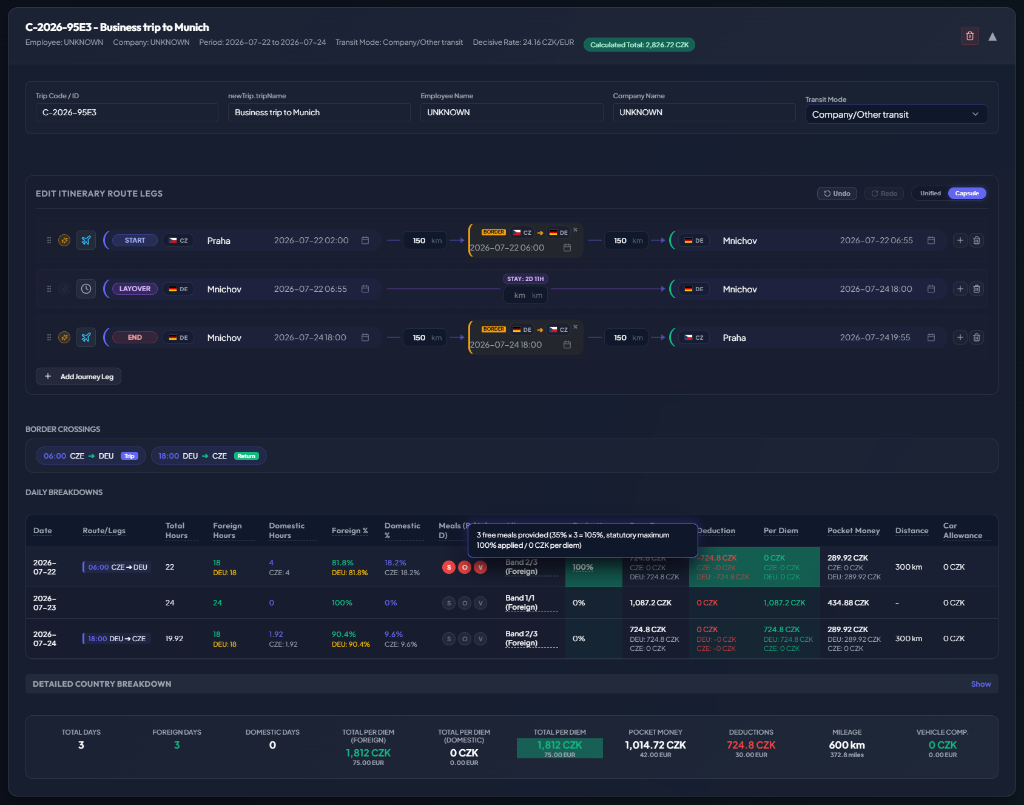
Statutory 100% Deduction Capping:
In partial-day duration tiers (12–18 hours or 1–12 hours), the mathematical sum of deductions for provided meals can exceed 100% (e.g. 3 × 35% = 105% or 2 × 70% = 140%).In such scenarios, PerDiemo's calculation engine automatically enforces statutory capping at 100%. An employee cannot be charged a negative per diem balance – the allowance balance reduces cleanly to 0 EUR / 0 CZK.
---
4. Qualifying Meals vs. Incidental Refreshments
Accurate payroll processing requires distinguishing between a full qualifying meal and minor travel refreshments:
Meals that TRIGGER statutory deductions:
- Breakfast: Warm or cold breakfast provided by lodging facilities (hotel buffet) or organized by an event host (at a conference).
- Lunch: One- or multi-course lunch served in a restaurant, company cafeteria, conference banquet, or at another dining facility.
- Dinner: Evening meal of equivalent substance provided by the employer or client.
- Statutory Condition: The employee incurs no financial contribution toward the meal.
Refreshments that DO NOT trigger deductions:
- Light Refreshments: Coffee, tea, bottled water, mineral water, and soft drinks.
- Transit Snacks: Crackers, a small sandwich, nuts, or a miniature snack served on board an aircraft or train.
- Conference Coffee Breaks: Welcome hors d'oeuvres or mini-pastries served between lecture sessions, provided they do not replace a full sit-down lunch or dinner.
---
5. Hotel Breakfast Included in Lodging Rates
The most frequent accounting scenario involves hotel folios marked "Breakfast included" / "Room rate includes buffet breakfast":
1. Employer Expense: Lodging costs are paid by the employer (via corporate billing or reimbursement of the employee expense report).
2. Legal Assessment: Even if breakfast is not broken out as an individual line item on the hotel receipt, food was provided to the employee free of personal expense.
3. Mandatory Reduction: The employer must reduce the per diem for that calendar day by the statutory percentage (e.g. 25% for a full-day foreign stay).
4. Voluntary Forfeiture: If an employee chooses not to eat the provided breakfast (e.g. overslept or departed early by personal choice), they cannot claim an unreduced allowance. An unreduced per diem is justifiable only if breakfast was objectively unavailable (e.g. checkout prior to restaurant operating hours without a takeaway option).
---
6. Prohibition of Concurrence with Meal Vouchers (§ 6(9) ZDP)
Under Section 6(9)(b) of the Czech Income Tax Act, strict statutory rules govern the simultaneous receipt of travel per diems and tax-advantaged meal subsidies (meal vouchers, meal stipend / stravenkový paušál):
- Core Principle: An employer's meal contribution is tax-exempt on the employee side ONLY IF the employee did not become entitled to travel meal allowances during that shift (i.e. business travel lasted less than 5 hours).
- Taxation Risk for Employees: If a company provides both travel per diems and a meal contribution (stipend/voucher) for the same shift, this meal contribution loses its tax-exempt status. The financial authority classifies it as taxable employee income from dependent activity (wages). The payroll department must subject it to wage tax withholding as well as compulsory social security and health insurance contributions.
- Tax Deductibility for Employers: Since January 1, 2024 (following the complete repeal of Section 24(2)(j)(4) ZDP by the Czech Consolidation Package), employer-provided meal contributions remain fully tax-deductible expenses for the employer under the general rule of Section 24(2)(j)(5) ZDP (provided they are anchored in internal regulations, collective agreements, or employment contracts). However, the payroll administration burden and employee-side tax friction of grossing up and withholding taxes make concurrence highly undesirable in practice.
---
7. Foreign Pocket Money and Free Meals (§ 180 ZP)
On international travel, employers may provide employees with tax-free pocket money (kapesné) of up to 40% of the per diem:
- Calculation Base: Pocket money is calculated against the awarded per diem tier (1/1, 2/3, or 1/3 bracket) BEFORE meal deductions are applied.
- Immunity from Meal Deductions: Providing free breakfast, lunch, or dinner never reduces pocket money. Even when per diems drop to 0 EUR after deductions (e.g. in Tier 2/3 with 3 meals), the employee retains full entitlement to the approved pocket money.
---
8. Practical Entry & Automated Workflows in PerDiemo
PerDiemo automates meal recording, statutory calculations, and compliance documentation:
1. Itinerary Trip Editor:
In every travel day or lodging card, users toggle provided meals with single-click buttons: B (Breakfast), L (Lunch), D (Dinner) or their localized equivalents.
2. Magic Wand:
When importing hotel folios, confirmation emails, or tickets, the intelligent parser detects keywords ("breakfast included", "full board", "snídaně v ceně") and automatically preselects the relevant free meals.
3. Transparent Auditor Breakdown:
Both in the dashboard and exported reports, PerDiemo provides itemized auditor annotations:
"2 free meals provided (25% × 2 = 50% per diem deduction / 50% net allowance remains)"
Corporate payroll accountants and external tax auditors can inspect the calculation rationale instantly with complete statutory certainty, ensuring full parity between the application interface and exported files.