Many companies and HR departments, weary of collecting physical receipts, calculating mileage, and manually reconciling travel reports, decided to switch to flat-rate travel allowances under § 182 of the Czech Labor Code. A common myth circulated among managers and entrepreneurs: "Let's set a flat rate in our internal guidelines, pay it out alongside monthly salaries, and eliminate travel expense reports and trip logs forever."
This assumption, however, has proven to be a catastrophic mistake, costing companies millions in back taxes, social and health insurance levies, and penalties.
As highlighted in a March 2026 tax alert by tax advisors at EY Czech Republic (Radek Matuštík, Partner in Tax Advisory, and Petr Sedláček), the Supreme Administrative Court (SAC / NSS) has firmly confirmed in a series of landmark rulings that flat-rate travel allowances in no way exempt employers from the obligation to maintain underlying evidentiary records proving that business travel actually took place.
---
1. The Manuvia Case: 4 Million CZK Tax Assessment and Rejected Appeal
The ruling of the Supreme Administrative Court No. 3 Afs 97/2025 – 71 dated 11 March 2026 (following earlier SAC judgments No. 8 Afs 50/2024 – 63 and No. 9 Afs 58/2024 – 46) serves as a stark warning for all corporate employers.
In this case, a temporary staffing agency paid its assigned employees flat-rate allowances alongside their wages, declaring them as tax-exempt travel allowances under § 182 of the Labor Code. During a payroll tax audit covering multiple fiscal years, the tax authority concluded that the taxpayer failed to prove entitlement to tax exemption under § 6(7)(a) of the Czech Income Tax Act. The result? An additional tax assessment of approximately 4 million CZK, plus substantial late-payment interest and statutory penalties.
The Taxpayer's Failed Defense
The company argued in court that:- The fundamental purpose of the flat-rate regime is to reduce administrative overhead, meaning tax authorities should only review the abstract mathematical formula of the flat rate, rather than individual trips.
- Retroactively requiring trip-by-trip proof and travel facticity constitutes an excessive and unlawful burden of proof.
The Supreme Administrative Court categorically dismissed this argument, emphasizing that statutory travel allowances arise exclusively when a business trip was actually and factually performed under § 151 and § 152(a) of the Labor Code.
---
2. The Dual Burden of Proof: What Must Employers Prove?
In its reasoning, the court clarified that employers utilizing flat-rate travel allowances bear a dual burden of proof during tax audits:
A. The Normative Tier: Rational Calculation and Flat-Rate Construction
Under § 182(2) of the Labor Code, the employer must be able to present documentation substantiating how the flat rate was determined.The court ruled that flat rates cannot be determined arbitrarily. Employer documentation must transparently prove:
- The reference period and employee sample used for the calculation (e.g. historical average expenses over at least 3 months).
- Which specific expense categories are covered (fares, per diems, lodging).
- Differentiation by travel distance and destination. The court criticized the employer for applying an identical flat rate to trips of 25 km, 50 km, and 65 km alike.
- Transport mode distinctions (private vehicles, company cars, public buses, trains).
- Rules for proportional deductions when an employee does not work the full scheduled period (e.g. sick leave, holidays).
B. The Factual Tier: Travel Facticity and Underlying Evidence
Even if the mathematical model of the flat rate is flawless, it is purely normative. It does not prove that employees actually embarked on business trips. (We analyze the material burden of proof in detail in our companion article What Is Facticity of Business Trips and How to Prove It).During the audit, the tax office discovered severe evidentiary flaws:
1. Residence Matching Work Location: Several sampled employees resided in the exact municipality where their client assignment took place. When an employee works in their home town, no statutory business trip exists, and travel allowances cannot legally arise (§ 153 of the Labor Code).
2. Duplicate & Free Provisions: While paying flat travel allowances, the agency simultaneously billed clients for collective bus shuttles or provided company dormitories. Furthermore, clients provided free factory canteen meals without corresponding statutory meal reductions under § 163 of the Labor Code.
3. Aggregated Lump-Sum Summaries: The employer's collective travel orders contained only employee names and aggregate monthly totals, lacking individual dates, route legs, departure timestamps, or hours worked.
---
3. The Tax Trap: Reclassification into Taxable Wages
When an employer fails to meet this dual burden of proof, tax authorities enforce the worst-case scenario:
1. Loss of Tax Exemption: Disbursed allowances lose exemption status under § 6(7)(a) of the Income Tax Act.
2. Reclassification as Taxable Wages: The full allowance amount is reclassified as standard employment income under § 6(1) of the Income Tax Act.
3. Severe Financial Consequences:
- 15% (or 23%) personal income tax assessment.
- Employer social security contributions: 24.8% + employee contribution 7.1%.
- Employer public health insurance: 9.0% + employee contribution 4.5%.
- A 20% statutory penalty under the Tax Code and compound late-payment interest across all audited fiscal years.
What started as an administrative shortcut turns into an existential corporate liability.
---
4. How PerDiemo Guarantees Audit-Proof Underlying Evidence
The rulings of the Supreme Administrative Court and analysis by EY advisors make one thing clear: flat-rate schemes without rigorous underlying records are a legal minefield. Why risk millions in tax assessments when modern software automates genuine travel expense compliance?
The PerDiemo platform is engineered specifically to provide the exact evidentiary depth demanded by tax auditors and labor inspection authorities:
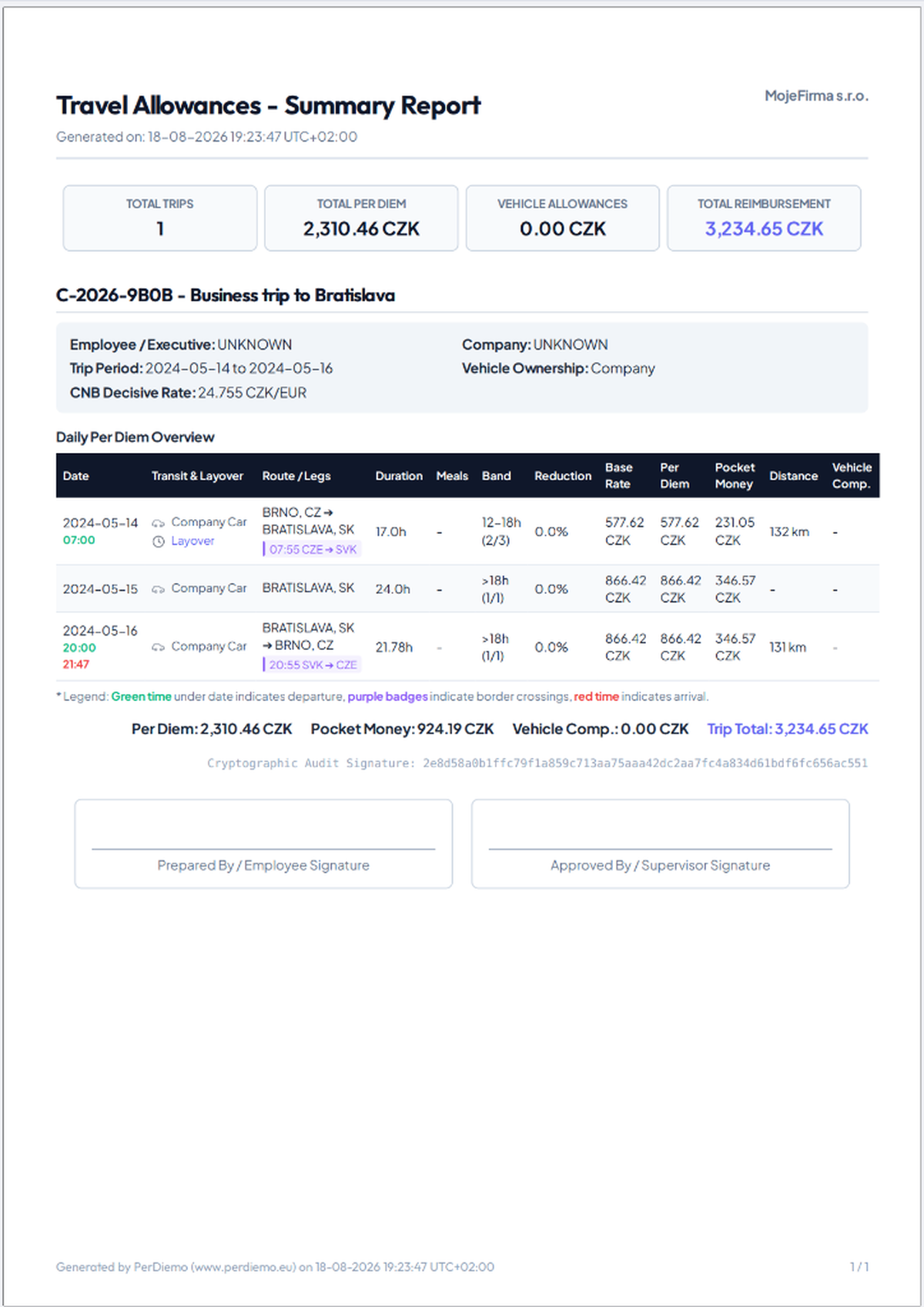
PerDiemo Capabilities Directly Addressing Court Demands:
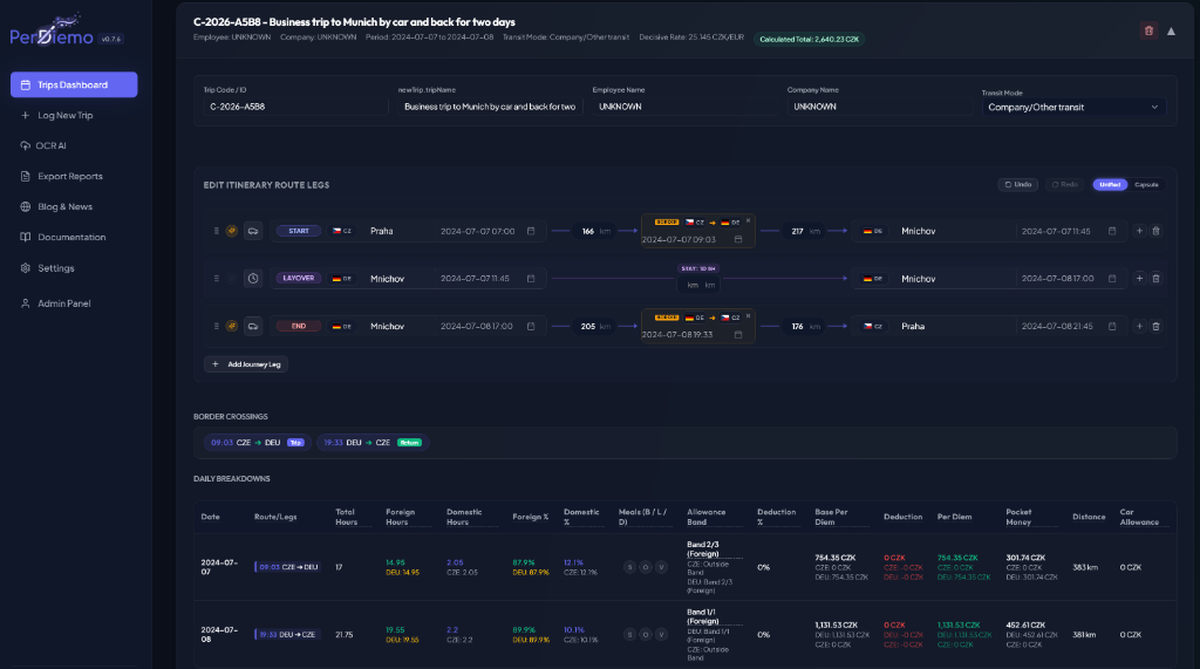
1. Digital Itinerary with Precise Timestamps: Every trip captures exact departure times, border crossings, destinations, arrival timestamps, and return times (see our quick-start travel expense guide).
2. Verification of Origin and Residence (§ 153 Labor Code): The system records exact departure and destination addresses, proving trips did not originate and terminate in the same municipality where the employee resides.
3. Transport Mode Differentiation: Explicitly tracks company cars, public transit, flights, and private vehicles, automatically applying statutory mileage amortization and fuel compensation formulas based on official Ministry decrees (detailed in our vehicle reimbursements and mileage guide).
4. Border Crossings & Multi-Country Transit (§ 166 & § 170 Labor Code): Automated border crossing timestamps cleanly divide domestic and international allowance bands (explore our border crossings and OZZ guide and article on International Business Travel & Per Diems). For air travel, the engine applies a recommended 3-hour pre-flight check-in buffer based on standard travel practice.
5. Statutory Meal Deductions (§ 163 & § 179 Labor Code): Transparent tracking of hotel breakfasts, provided lunches, and dinners, enforcing statutory reduction tiers and the mandatory 5% foreign per diem retention rule.
6. Official ČNB Exchange Rate Binding (§ 183 Labor Code): Automated synchronization with official daily Czech National Bank exchange rates as of the departure date or advance payout date (see CNB exchange rates and currency advances).
7. Cryptographic SHA-256 Audit Hash & QR Codes: Generated PDF reports feature tamper-proof SHA-256 cryptographic signatures and QR verification codes (learn more in cryptographic PDF report documentation), providing indisputable evidence of document integrity during audits.
---
5. AI Magic Wand: Eliminating Administrative Friction
Historically, employers resorted to risky flat rates because manually calculating business trips took 30 to 45 minutes per report.
With PerDiemo's AI Magic Wand, that administrative barrier disappears completely (explore Generative AI vs. Magic Wand or our guide How to Calculate Per Diem in 10 Seconds Using PerDiemo AI Magic Wand):
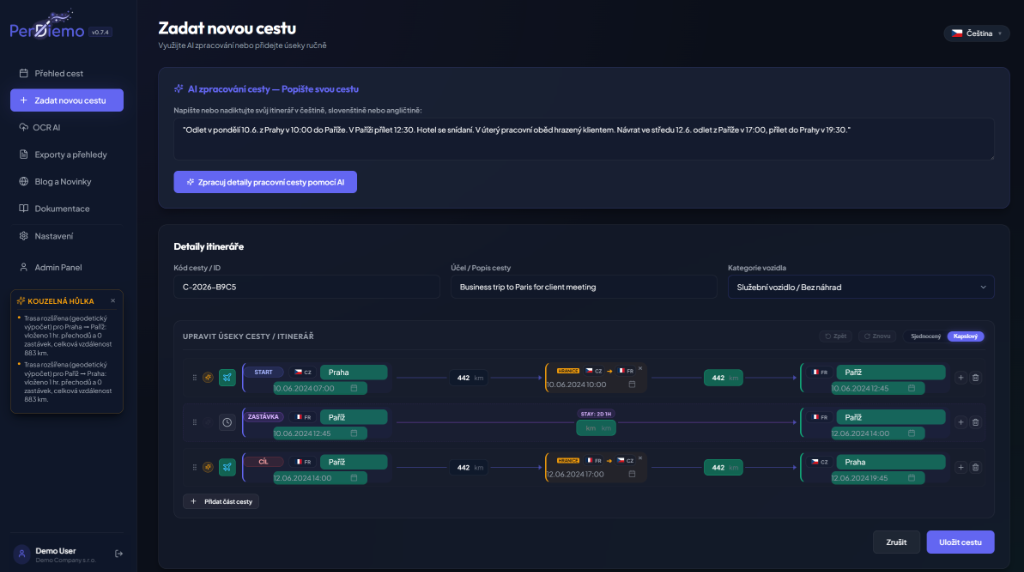
- Employees or accountants simply paste informal notes from emails, calendars, or messages (e.g. "Monday 7:00 AM departure from Brno by company car to Vienna, return Tuesday 18:00, free hotel breakfast").
- In under 10 seconds, the AI engine extracts a structured, fully compliant itinerary with exact time bands, ČNB currency conversions, and meal deductions.
- The result is 100% compliance with Czech Labor Code No. 262/2006 Coll. and complete peace of mind during tax audits.
---
Conclusion: Never Neglect Underlying Travel Records
Supreme Administrative Court ruling No. 3 Afs 97/2025 – 71 delivers an unmistakable verdict: paying flat-rate travel allowances without comprehensive underlying records of actual trips is an open invitation to massive tax penalties.
Ensure your travel expense accounting is 100% audit-proof. Try automated travel allowance calculation at www.perdiemo.eu — your first 10 trips per year are completely free.