In corporate accounting and tax practice, a dangerous myth stubbornly persists: "As long as we have a company stamp, the employee's signature, and executive approval on the expense report, the tax office cannot touch us."
During an actual tax audit, this assumption shatters against hard legal realities, as emphasized by tax advisors at EY Czech Republic (Radek Matuštík, Partner in Tax Advisory, and Petr Sedláček). Neither tax inspectors nor Supreme Administrative Court (SAC / NSS) judges are satisfied with formally flawless paperwork. The pivotal legal concept determining whether travel expense deductions stand or fall in all formal disputes is the facticity of business trips (fakticita pracovních cest).
As analyzed in detail in our article on Flat-Rate Travel Allowances and the Landmark SAC Ruling (the Manuvia case, ruling No. 3 Afs 97/2025 – 71), an employer (a temporary staffing agency) was assessed over 4 million CZK in back taxes and penalties precisely because they could not substantiate the material facticity of reported travel.
In this article, we define what facticity actually means, what burden of proof employers and employees bear under the Tax Code, and present a clear comparison table demonstrating how the PerDiemo platform addresses this statutory obligation.
---
1. What Does "Facticity" Actually Mean in Tax & Labor Law?
The term facticity derives from the Latin factum (act, reality, factual state). In statutory doctrine, it represents material proof that the declared event actually and physically occurred in the real world, exactly as formally represented in the taxpayer's accounting records.
Under Sections § 151 and § 152(a) of the Czech Labor Code, travel allowances are legally payable solely for expenses “incurred by an employee during a business trip.” The legal implications are unequivocal:
- A travel reimbursement right cannot arise from merely filling out and stamping a form.
- Entitlement arises solely and exclusively when the employee physically executed the business trip.
- If a trip never physically occurred (or took place under materially different conditions than reported), disbursed funds cannot qualify as tax-exempt travel allowances under § 6(7)(a) of the Czech Income Tax Act. Instead, they are reclassified into taxable employment income subject to mandatory levies (health and/or social insurance contributions).
---
2. Evidentiary Obligation under Section 92 of the Tax Code
The most critical hurdle during tax inspections is the distribution of the burden of proof. Under § 92(3) of the Czech Tax Code (Act No. 280/2009 Coll.), the burden of proof regarding all items declared in tax returns rests fully upon the taxpayer (employer), citing the statute:
The taxpayer proves all facts that they are obliged to state in tax returns and other statutory submissions
.
How the Tax Office Proceeds When Proving a Business Trip
1. Submission of Formal Records: The employer provides signed logbooks, travel orders, or flat-rate payroll summaries. 2. Raising Qualified Doubts: The tax auditor does not need to prove the trip did not occur. It suffices to identify credible discrepancies that cast qualified doubt on the reported facts (§ 92(5)(c) of the Tax Code):- The employee resides in the exact same municipality where the assignment took place (under § 153 of the Labor Code, this does not constitute a statutory business trip; see domestic per diem conditions and the 5-hour rule).
- Timestamps contradict each other, do not match electronic badge attendance logs, or violate the geographic reality of the journey.
- The company billed clients for collective staff shuttle buses while simultaneously reimbursing employees for individual car journeys, which is a direct logical contradiction.
- Free canteen catering was demonstrably provided at the workplace without statutory meal deductions under § 163 of the Labor Code.
---
3. What and How PerDiemo Implements for Employers: Clear Comparison Table
The PerDiemo platform was built from the ground up alongside tax advisors to establish an unbroken chain of underlying evidence that withstands scrutiny from tax auditors.
The table below transparently outlines what tax audits require, how PerDiemo implements each pillar, and where software boundaries lie:
| Evidentiary Pillar of Facticity (Tax Office / SAC) | What Statute & Tax Audits Require | How PerDiemo Implements It | Support Status in PerDiemo |
|---|---|---|---|
| 1. WHO Traveled (Subject & Relationship) | Unambiguous identification of the specific employee or executive; elimination of anonymous lump sums. | The travel order is strictly bound to the employee's profile, full name, and organization. The specific person is explicitly identified in both PDF and data records. | FULLY SUPPORTED |
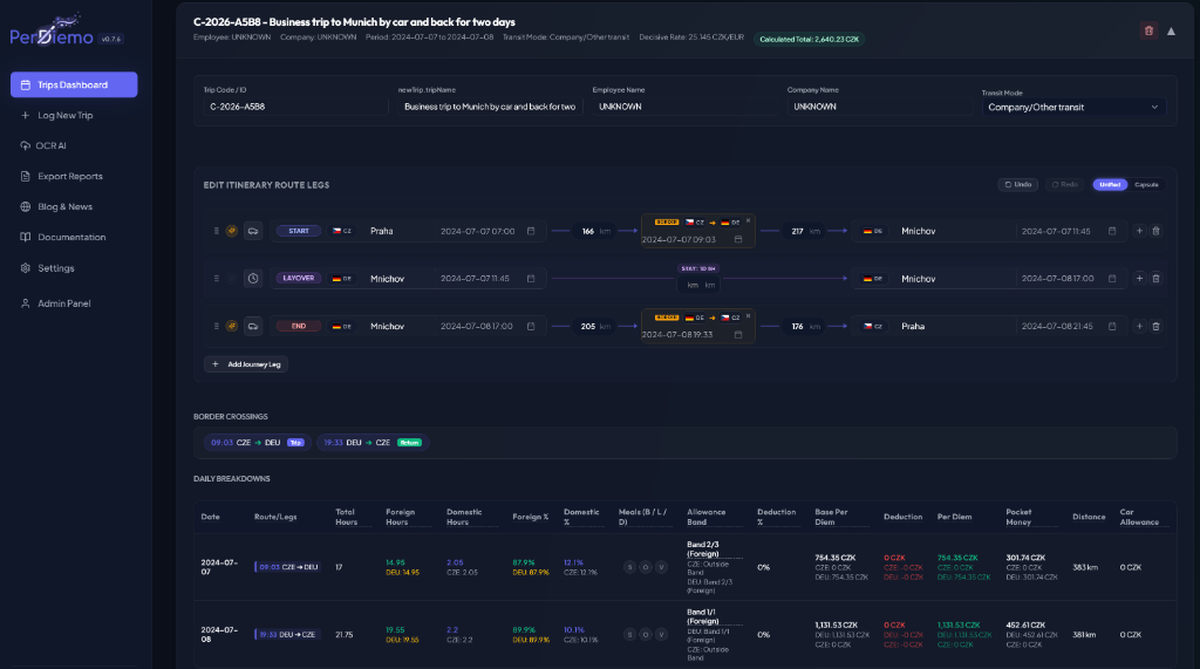
| 2. WHEN Travel Occurred (Timeline & Tiers) | Precise departure, waypoint (border), and return timestamps to determine statutory allowance tiers (§ 163 and § 170 Labor Code). | Every itinerary leg captures exact dates and times (`hh:mm`). The algorithm automatically partitions trips across calendar days and assigns statutory domestic per diem tiers (1/3, 2/3, 3/3). | FULLY SUPPORTED |
| 3. WHERE (Origin vs. Residence) | Determining departure point under § 153 Labor Code. Excluding fictitious trips where the employee resides in the work municipality. | Explicit entry of departure address, transit waypoints, and destination. Geocoding validates real routes based on physical road existence and generates an unalterable daily route string (`PRAGUE ➔ BRNO`). | FULLY SUPPORTED |
| 4. BORDER CROSSINGS (International Transit) | Exact timestamp of crossing national borders (§ 166 Labor Code) to separate domestic and foreign per diems and select decisive country (§ 170 Labor Code). | Automated detection and logging of border checkpoints (detailed in our border crossings and OZZ guide and blog post Multi-Country Transit & OZZ Fallback). For flights, the system applies a recommended 3-hour pre-flight check-in buffer. Transit legs under 1 hour are automatically summed. | FULLY SUPPORTED |
| 5. HOW (Transport Mode) | Differentiating private vehicles (eligible for mileage amortization and fuel compensation under Ministry decree) from company cars, flights, or trains. Protection against unjustified depreciation claims. | Granular transport mode categorization per route leg. For company vehicles or flights, automatically zeroes out basic mileage and fuel compensation. For private vehicles, computes statutory amortization and fuel rates for the given year (see vehicle reimbursements and mileage documentation). | FULLY SUPPORTED |
| 6. UNDER WHAT CONDITIONS (Free Meals) | Mandatory per diem reductions for free breakfasts, lunches, and dinners (hotel, conference, client, catering) under § 163 and § 179 Labor Code. | Meal provision checkboxes per calendar day. Automatically calculates statutory reductions for domestic and foreign trips, enforcing the 5% foreign per diem retention rule. | FULLY SUPPORTED |
| 7. FINANCIAL CONVERSION (ČNB Rates) | Statutory currency conversion using official Czech National Bank (ČNB) exchange rates as of departure date (Section 183 (4) of the Labor Code) or advance payout date (§ 183(2) Labor Code). | Automated fetching of official daily ČNB rates via API for decisive dates (see CNB exchange rates and currency advances). Exchange rates are displayed transparently in the PDF header for tax audit verification. | FULLY SUPPORTED |
| 8. WHY (Business Purpose) | Substantiating expense causality with generating and maintaining taxable revenues (§ 24(1) Income Tax Act). | Dedicated "Business Purpose" field (e.g. Client Meeting XY, On-site Service Contract #123) rendered across PDF reports and all accounting exports, editable by employee. | FULLY SUPPORTED (content defined by firm) |
| 9. DOCUMENT INTEGRITY (Anti-Tampering) | Proof that the travel order was not backdated or altered retroactively upon receiving audit notices. | Generation of official PDF with a SHA-256 cryptographic hash and timestamp (learn more in cryptographic PDF report documentation). Guarantees immutability of calculation and temporal integrity of the document. | FULLY SUPPORTED |
| 10. EXTRACTION FROM REAL ARTIFACTS (Tickets / Emails) | Linking expense reports to genuine primary artifacts (emails, flight tickets, hotel bookings). | AI Assistant extracts data from emails/calendars and Magic Wand deterministically determines exact distances and times into the itinerary (see Generative AI vs. Magic Wand and blog post From Informal Text to Calculated Travel Report). | FULLY SUPPORTED |
| 11. HARDWARE TELEMATICS (Live GPS Tracking) | Real-time vehicle location tracking via onboard satellite GPS hardware in vehicle. | PerDiemo is not a GPS tracking unit (hardware OBD-II). It computes route distances and coordinates, but does not track live vehicle telematics on a map. | NO (Out of Scope) (recommended to combine with GPS) |
| 12. MEETING MINUTES ARCHIVAL (DMS) | Archiving signed attendance sheets, contracts, or handover protocols from business meetings. | PerDiemo logs purpose and trip dates, but is not a complex Document Management System (DMS) / contract repository. | NO (Employer Archive) (firm archives in CRM/accounting) |
4. Protection Against Unjustified Mileage Claims
One of the most frequent traps during tax audits is the incorrect reporting of vehicle reimbursements. If an employee drives a company car or travels by air, but accounting mistakenly includes depreciation compensation for a private vehicle (mileage allowance), the tax office will immediately challenge the report as fictitious, even though it may have been a simple negligent mistake. PerDiemo never allows this type of error to occur.
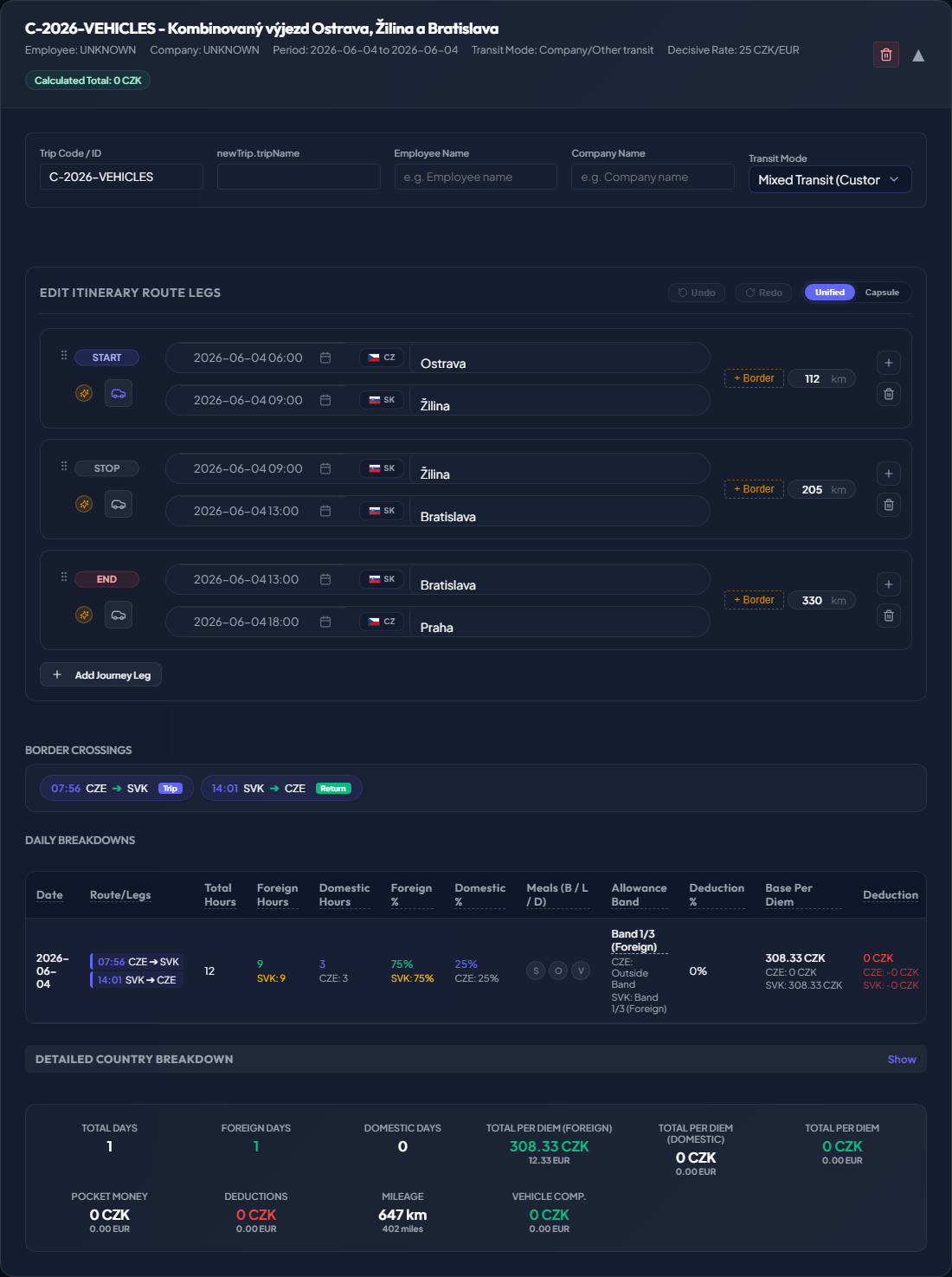
PerDiemo enforces strict transport mode partitioning leg-by-leg:
- If a leg is designated as company car, air travel, or public transit, the system automatically zeroes out both the basic mileage rate and fuel compensation.
- Mileage compensation and fuel reimbursements are computed strictly on legs using private vehicles, adhering strictly to valid Ministry decrees for the given fiscal year (detailed in our vehicle reimbursements and mileage methodology). Data is automatically updated for each tax year.
---
5. Digital Non-Repudiation: Cryptographic SHA-256 Hashes in PDF Exports
Tax authorities during audits frequently verify whether travel orders were manufactured expediently only after receiving an audit notice.
PerDiemo resolves this issue right at the core of document generation:
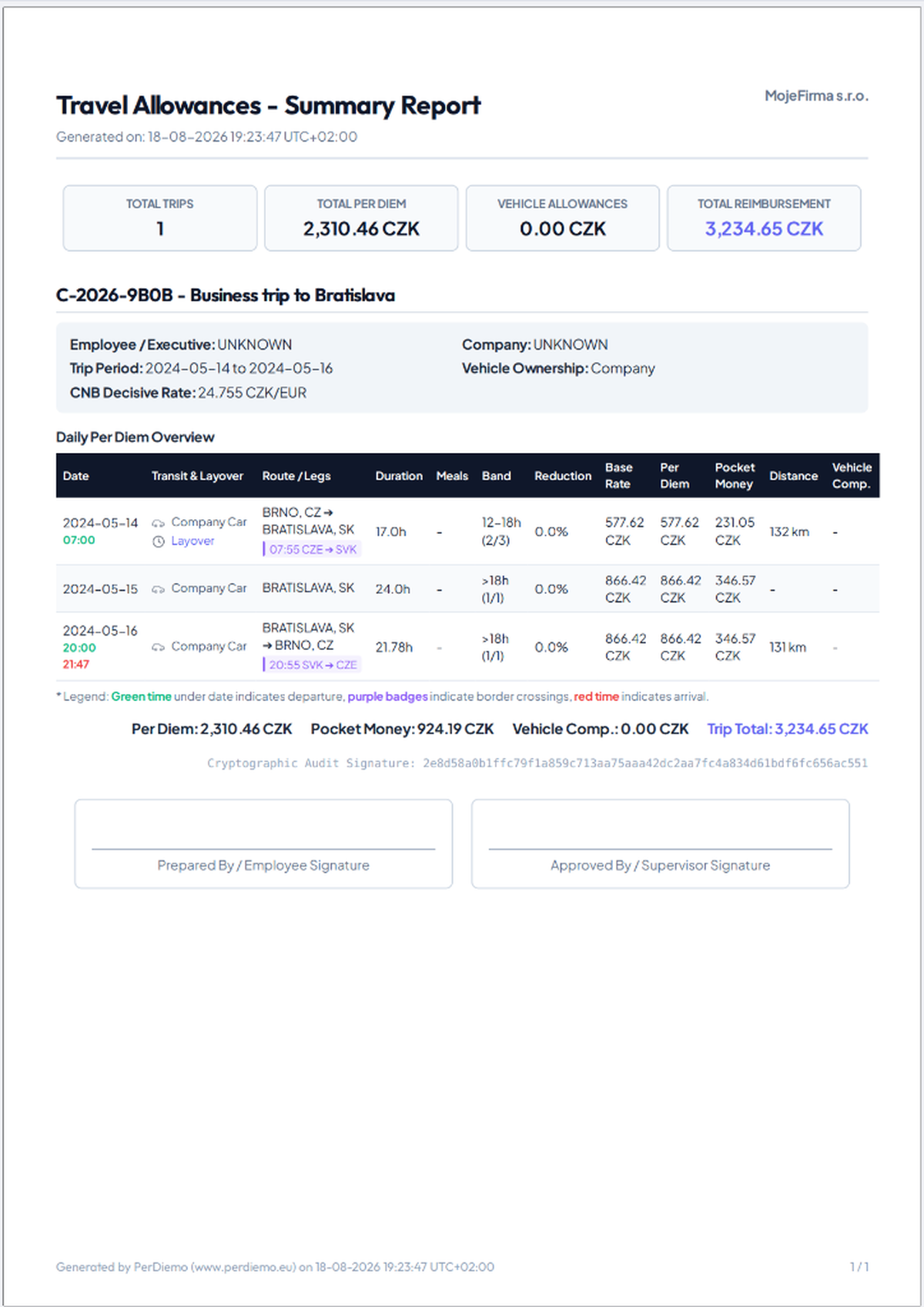
Every expense settlement generated in PDF format bears a unique SHA-256 cryptographic hash in its footer and verifies the export timestamp (see our guides on cryptographic PDF reports and read-only export formats CSV, JSON, XML). This fingerprint unambiguously seals the itinerary content, dates, times, and calculated amounts. Any subsequent modification to the document invalidates the hash. For audit authorities, this provides clear proof of the integrity and authenticity of the submitted data.
---
Conclusion: Where Does Software Responsibility End and Corporate Responsibility Begin?
The difference between a successful tax audit and a multi-million-crown penalty lies in understanding the division of roles:
1. What PerDiemo Delivers: Impeccable, legally watertight underlying evidence — precise timestamps, routes, ČNB currency conversions, border crossings, meal deductions, and protection against double-billing vehicle mileage.
2. What Your Company Substantiates: The business purpose of the trip — proving that meeting with the client was genuinely tied to your economic activity (e.g. email communication, purchase orders, meeting minutes, or service protocols), which no automation or software can solve alone since it substantiates a factual basis in the real world.
Do not leave your travel allowances in the grey zone of formal paperwork. Try modern, audit-safe travel expense processing at www.perdiemo.eu — your first few trips are completely free.