When an employee embarks on an international business trip from the Czech Republic, statutory per diem allowances are decreed by the Ministry of Finance in foreign currency — most commonly in Euros (EUR), US Dollars (USD), or Swiss Francs (CHF).
However, Czech corporate bookkeeping, payroll ledgers, and bank disbursements are statutorily denominated in Czech Koruna (CZK). To properly recognize per diems as corporate tax-deductible expenses and execute payroll transfers, companies must perform currency conversions.
This creates one of the most widespread accounting disputes in Czech business: Which Czech National Bank (CNB) exchange rate is legally decisive? Is it the rate on departure date, return date, settlement submission date, or a monthly accounting average?
The statutory directives codified in Section 183 of the Czech Labor Code are definitive. In this guide, we analyze which date governs conversions, substantiate the rules with Supreme Administrative Court jurisprudence and Czech Financial Administration guidelines, and illustrate the workflow in a structured visual infographic diagram.
---
1. Primary Scenario: Trips Without Cash Advances (§ 183 (4) LC)
In modern corporate practice, businesses rarely disburse physical foreign cash banknotes before travel. Employees travel with corporate cards or private funds and reconcile claims retroactively.
Under Section 183 (4) of the Czech Labor Code:
“When providing reimbursements for which no advance payment was disbursed, the foreign exchange rate decreed by the Czech National Bank valid on the date of departure on the foreign business trip shall apply.”
What Constitutes the “Departure Date on a Foreign Business Trip”?
Under Czech labor jurisprudence: For automotive and railway transport: The calendar day on which the physical crossing of the Czech state border into foreign territory occurred. Statutory authority: Section 154 (1) of the Labor Code ("The decisive time for the accrual of the employee's entitlement to reimbursement of travel expenses in foreign currency is the time of crossing the state border of the Czech Republic..."*). For air transport: The calendar day of scheduled flight departure from the Czech Republic as stated on the flight ticket/manifest. Statutory authority: Section 154 (1) of the Labor Code ("...in air transport, departure from the Czech Republic and arrival in the Czech Republic."*).---
2. Secondary Scenario: Trips With Foreign Currency Advances (§ 183 (2) LC)
When an employer disburses an advance in foreign currency prior to departure, Section 183 (2) of the Labor Code mandates that:
The CNB exchange rate valid on the date the advance was disbursed governs the conversion for the entire advance sum.
If net travel expenses exceed the advance, the surplus is converted using the departure date exchange rate pursuant to subsection 4.
---
3. Decision Diagram: Two Statutory Scenarios for CNB Rate Conversion
The following visual decision architecture illustrates the two legal mechanisms governing exchange rate selection under Czech law:
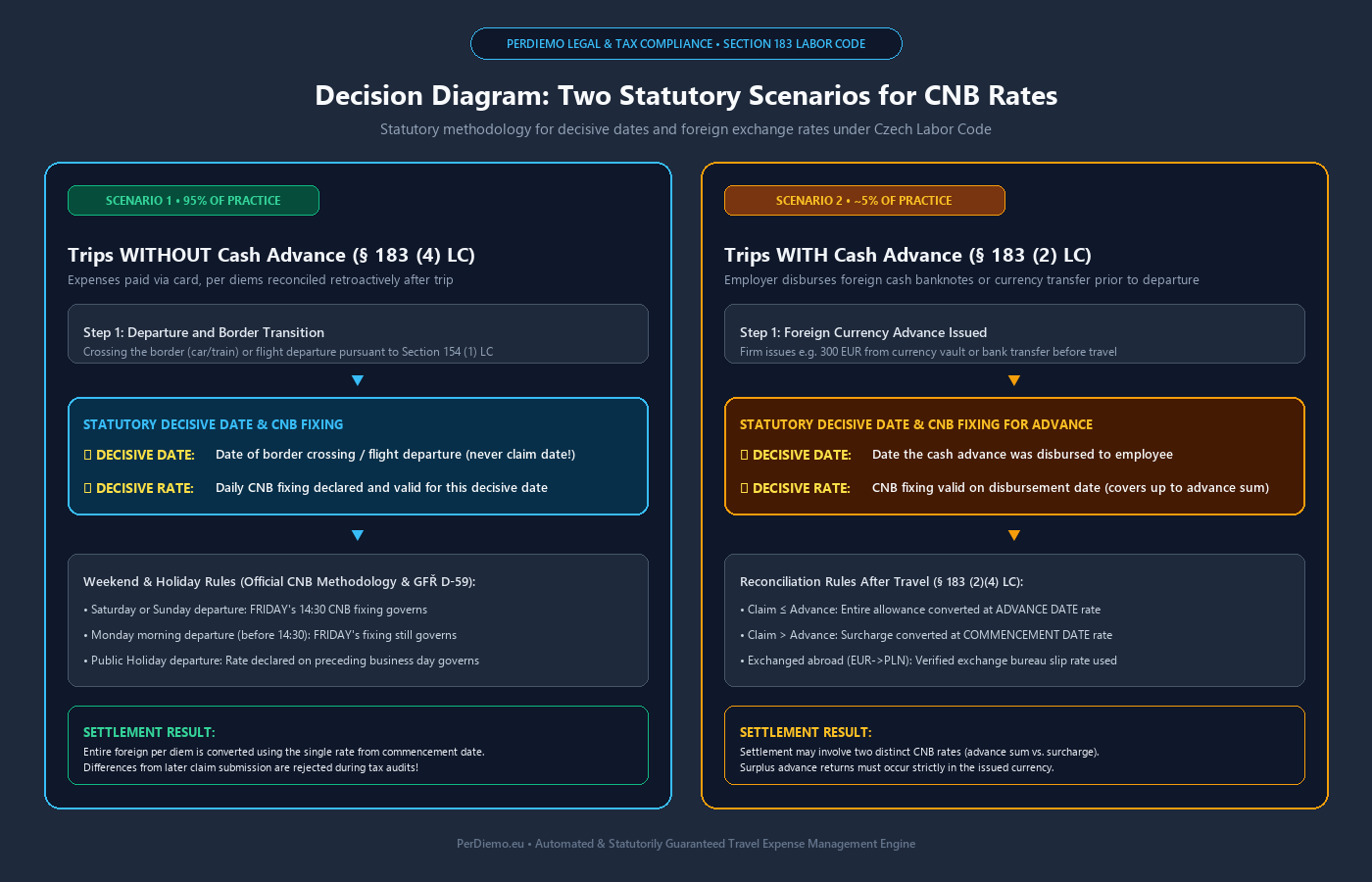
Comparative Breakdown:
| Evaluation Criteria | Scenario 1: No Cash Advance (§ 183 (4) LC) | Scenario 2: With Cash Advance (§ 183 (2) LC) |
|---|---|---|
| Corporate Prevalence | 95% of corporate travel claims | ~5% (only when physical foreign cash is issued) |
| Decisive Timestamp | Date of border crossing / flight departure (§ 154) | Date cash advance was paid to employee |
| Applied Exchange Rate | Daily CNB rate on date of foreign commencement | CNB rate on date advance was paid |
| Weekend & Holiday Rule | Friday afternoon CNB fixing at 14:30 CET | CNB rate on advance disbursement day |
| Surcharge Above Advance | Not applicable (entire trip uses one rate) | Excess converted at date of foreign entry |
4. The CNB Weekend Fixing Paradox: Rates for Saturday, Sunday, and Monday Morning
The Czech National Bank publishes foreign exchange fixing rates strictly on business days around 14:30 CET. This schedule is governed by the Official CNB Exchange Rate Methodology and General Financial Directorate Guideline GFŘ-D-59 on Section 24 (2) of the Income Tax Act.
This creates widespread operational confusion:
* Departure on Saturday or Sunday: The CNB publishes no rates on weekends. Under official central bank rules, Friday's 14:30 fixing remains legally effective for Friday and subsequent rest days (Saturday and Sunday).
* Departure on Monday morning (e.g. at 08:00 AM): On Monday morning, Monday's new fixing does not yet exist. Pursuant to Section 183 (1)(4) of the Labor Code and Guideline GFŘ-D-59, the only legally published rate is Friday's afternoon CNB fixing!
* Departure on a Public Holiday: If a holiday falls on a weekday (e.g. Thursday), the rate published on the immediately preceding business day (Wednesday at 14:30) governs.
---
5. Two Critical Currency Conversion Misconceptions and Court Precedents
During corporate tax inspections, Financial Administration auditors focus on common foreign exchange mistakes:
1. Misconception 1: “Using the exchange rate on the claim settlement date.”
Statutory & Judicial Reality: A common corporate mistake. If an expense report is processed 10 days post-travel and converted at contemporaneous rates, tax inspectors will invalidate the deductions. Under Section 24 (2)(zx) of the Czech Income Tax Act (No. 586/1992 Coll.), travel allowances are tax-deductible only when granted in strict compliance with the Labor Code*. As confirmed by the Supreme Administrative Court in landmark NSS Judgment No. 2 Afs 177/2016 (No. 3504/2017 Coll. NSS), tax deductibility is conditioned on mandatory Labor Code compliance — arbitrary conversion dates trigger disallowance of currency differentials, expense exclusion, and corporate tax reassessments.
2. Misconception 2: “Using commercial bank middle rates.”
Statutory & Judicial Reality: Section 183 explicitly mandates “the foreign exchange rate declared by the Czech National Bank”* (see Official CNB Rate Bulletin). Commercial banks (ČSOB, KB, Erste) apply proprietary commercial spreads. Using commercial rates violates statutory law and is rejected during tax audits.
---
6. Interaction With Statutory Meal Deductions
When free meals (breakfast, lunch, or dinner) are provided, reductions are computed first in the foreign currency under § 170 odst. 5 ZP (see our detailed breakfast and lunch deduction matrix).
Only the final net foreign per diem balance is converted into CZK using the decisive CNB rate.
---
7. How PerDiemo Automates CNB Rate Synchronization
Manually looking up historical central bank rates and managing weekend fixings introduces widespread errors and compliance risks.
With PerDiemo:
* The system is connected via live data pipelines to the Czech National Bank fixing archives.
* The calculation engine identifies border transition timestamps and automatically pairs the exact valid CNB rate.
* PDF reports and Pohoda XML exports detail the exact statutory rate and date, ensuring flawless tax audit verification (see our comparison of travel expense tools).
Calculate your international per diems with automated CNB rates at www.perdiemo.eu.