When sending an employee to an all-day conference, training seminar, trade expo, or corporate summit, the most frequent real-world scenario involves simultaneous provision of breakfast and lunch — typically complimentary hotel breakfast included with lodging, paired with catered lunch provided by event organizers.
For payroll accountants, finance directors, and traveling personnel, accurately calculating statutory per diem entitlements under Czech legislation is often deceptively complex (see our comprehensive user guide for per diem travel expense calculation). The Czech Labor Code applies fundamentally different mathematical mechanics depending on whether the travel represents a domestic business trip (Section 163 of the Labor Code) or an international business trip (Section 170 of the Labor Code).
In this guide, we analyze exact mathematical formulas, duration tiers, when allowances drop to zero, and why the 5% guarantee is a myth.
---
1. Statutory Definition of Free Meals
To legally reduce per diem allowances, two conditions codified in the Labor Code must be satisfied:
1. The meal was provided completely free of charge (no employee co-payment, deduction, or cash contribution).
2. The meal has the substantive character of breakfast, lunch, or dinner.
For scenarios involving solely hotel breakfast without additional meals, consult our dedicated guide on hotel breakfast meal deductions. Below, we focus specifically on the dual-meal scenario (breakfast + lunch).
---
2. Czech Domestic Business Trips: Reductions under Section 163
For domestic travel within the Czech Republic, reduction percentages depend strictly on total elapsed travel hours within a single calendar day (see our reference guide on the domestic per diem 5-hour rule and duration tiers). Under Section 163 (2) of the Labor Code, an employer may reduce per diem allowances for each provided meal by up to:
* 70% in Tier I (trip duration 5 to 12 hours)
* 35% in Tier II (trip duration 12 to 18 hours)
* 25% in Tier III (trip duration over 18 hours)
Here is what happens when both breakfast and lunch are provided:
A. Trips lasting 5 to 12 hours (Tier I)
* Breakfast reduction: up to 70% * Lunch reduction: up to 70% * Combined total reduction: 70 % + 70 % = 140 %. * Statutory Result: Reductions are capped at 100%. The employee is entitled to zero domestic per diem (0 CZK).B. Trips lasting 12 to 18 hours (Tier II)
* Breakfast reduction: up to 35% * Lunch reduction: up to 35% * Combined total reduction: 35 % + 35 % = 70 %. * Statutory Result: The employee receives the remaining 30% of the statutory Tier II allowance.C. Trips lasting over 18 hours (Tier III)
* Breakfast reduction: up to 25% * Lunch reduction: up to 25% * Combined total reduction: 25 % + 25 % = 50 %. * Statutory Result: The employee receives 50% of the full Tier III allowance.---
3. International Business Trips: Reductions under Section 170 (5)
Under Section 170 (5) of the Labor Code, foreign per diem reductions follow duration tiers analogous to domestic travel. The decisive border crossing is determined by travel mode and frontier timestamps (see our guide on border crossings and OZZ calculation and our guide to meal reductions and exports).
Under Section 170 (5), foreign per diems are reduced for each provided free meal (breakfast, lunch, dinner) by:
* 70% of foreign per diem in Tier I (1 to 12 hours abroad)
* 35% of foreign per diem in Tier II (12 to 18 hours abroad)
* 25% of foreign per diem in Tier III (over 18 hours abroad)
Combined Breakfast and Lunch Mechanics Abroad:
When both breakfast and lunch are provided abroad, the outcome depends strictly on elapsed time: 1. Over 18 hours abroad (Tier III): Reduction is 25% + 25% = 50%. The employee is entitled to 50% of the full base rate (e.g., at 50 EUR for Germany under Decree No. 489/2025 Coll., the net payout equals 50 EUR × 0.50 = 25.00 EUR). 2. 12 to 18 hours abroad (Tier II): The base is two-thirds of the decreed rate. Reduction is 35% + 35% = 70%. The employee receives 30% of the two-thirds rate (e.g., for Germany at 33.33 EUR, the payout is 33.33 EUR × 0.30 = 10.00 EUR). 3. 1 to 12 hours abroad (Tier I): The base is one-third of the decreed rate. Reduction is 70% + 70% = 140%. Reductions are capped at 100%, so the employee receives zero per diem (0 EUR).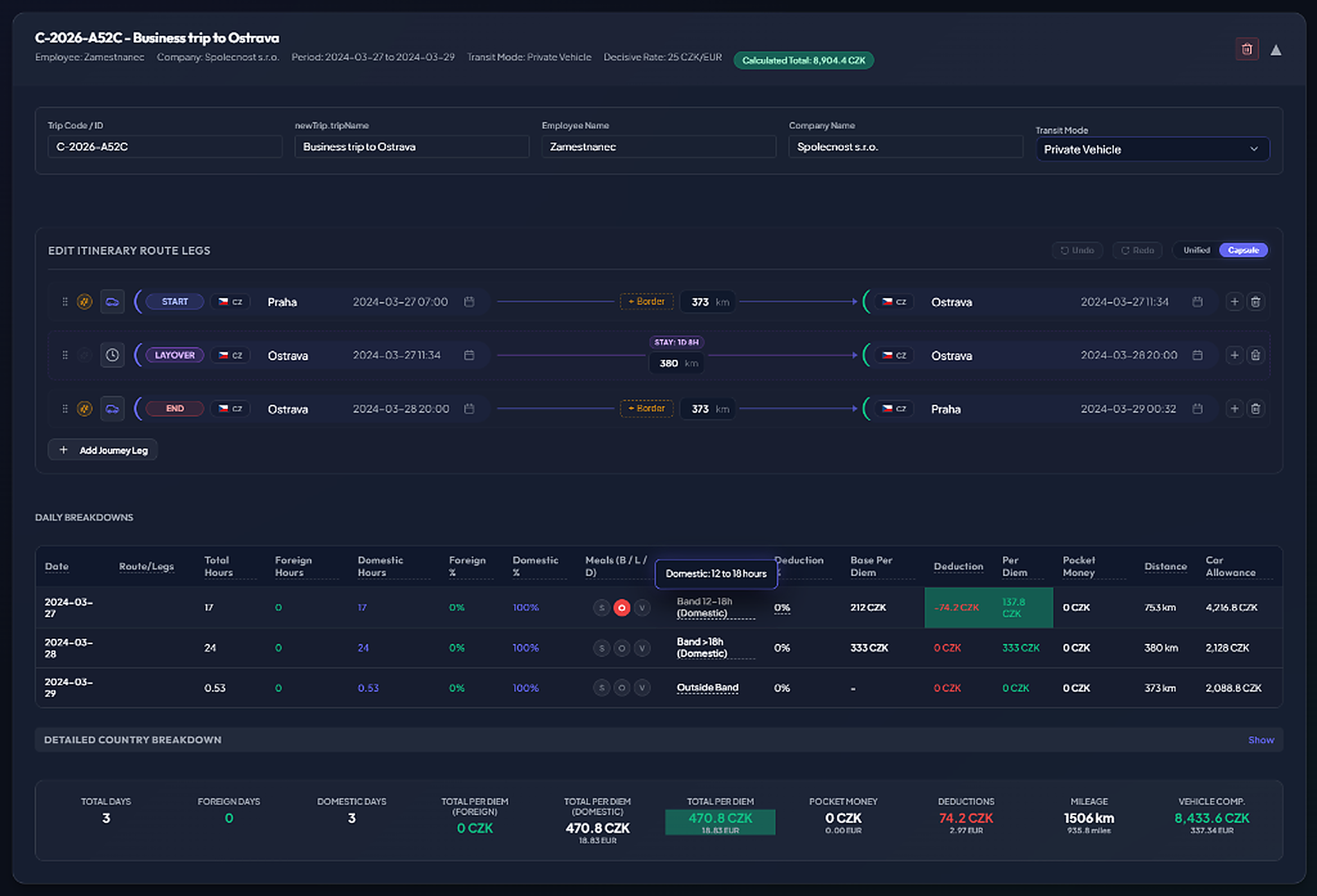
---
4. Direct Comparison: Domestic vs. Foreign Allowance Retention
The matrix below contrasts net payout percentages when both breakfast and lunch are provided:
| Duration Tier | Domestic Travel (§ 163 ZP) | International Travel (§ 170 ZP) |
|---|---|---|
| Short Duration (5–12 h CZ / 1–12 h Foreign) | 0% (70% + 70% = 140% → capped at 100%, 0 CZK) | 0% (70% + 70% = 140% → capped at 100%, 0 EUR) |
| Medium Duration (12–18 h) | 30% of decreed rate (35% + 35% = 70% reduction) | 30% of 2/3 base rate (35% + 35% = 70% reduction) |
| Full Day (Over 18 h) | 50% of decreed rate (25% + 25% = 50% reduction) | 50% of full base rate (25% + 25% = 50% reduction) |
---
5. What Happens When Dinner Is Added? Full Board Rules (3 Provided Meals)
When dinner is provided alongside breakfast and lunch (3 provided meals / full board):
* In Tier I (1–12 h abroad / 5–12 h domestic): 3 × 70% = 210% reduction → capped at 100% → 0 EUR / 0 CZK.
* In Tier II (12–18 h abroad / 12–18 h domestic): 3 × 35% = 105% reduction → capped at 100% → 0 EUR / 0 CZK.
* In Tier III (Over 18 h abroad / over 18 h domestic):
- Domestic travel: Under Section 163 (2)(c) of the Labor Code, 3 provided meals trigger a maximum legal reduction of 3 × 25% = 75%. Even with full board, the employee always legally retains at least 25% of the per diem (the statutory 25% reduction cap per meal is mandatory and employers cannot exceed it via internal policy).
- International travel: Under Section 170 (5) of the Labor Code, 3 meals trigger exactly 3 × 25% = 75% reduction. The employee retains 25% of the full base rate (e.g. for Germany, 50 EUR × 0.25 = 12.50 EUR).
---
6. Three Critical Payroll Accounting Pitfalls in Practice
1. Assuming foreign deductions are flat without regard to trip duration: Many accountants mistakenly assume breakfast is always 25% and lunch is always 35%. Under Section 170 (5) of the Labor Code, each meal is reduced based on duration tiers: 70% in Tier I, 35% in Tier II, and 25% in Tier III! For a short single-day trip abroad, two meals wipe out per diem entirely.
2. Confusing refreshments with meals: Deducting per diems for coffee breaks or light sandwiches is unlawful; reductions require substantial breakfast, lunch, or dinner.
3. Selecting incorrect exchange rate dates (§ 184 vs. § 183 (1)–(2) LC): Foreign per diems without an advance must be converted using the CNB rate on the departure date under Section 184 of the Labor Code (not the settlement date; § 183 (4) LC strictly governs reconciling an already disbursed advance). If a foreign currency advance was disbursed, the CNB rate on the advance date applies under Section 183 (1)–(2) LC. See our detailed guide on decisive CNB exchange rate fixing dates and our reference on CNB exchange rates and currency advances.
---
7. How PerDiemo Automates Meal Deductions
Manual calculation across multiple travel legs and currency conversions takes accountants up to 30 minutes per travel claim.
With PerDiemo, simply mark provided meals or let the AI Magic Wand extract them from your itinerary:
* The calculation engine enforces accurate statutory rules (§ 163 vs. § 170 ZP).
* Automatically determines decisive Czech National Bank exchange rates under Section 184 and Section 183 (1)–(2).
* Exports audit-proof PDF expense reports with SHA-256 cryptographic verification and read-only XML/CSV formats (see our comparison of travel expense tools).
Test your calculation with our online per diem calculator or explore our pricing tiers at www.perdiemo.eu — free tier includes 10 trips per year.